
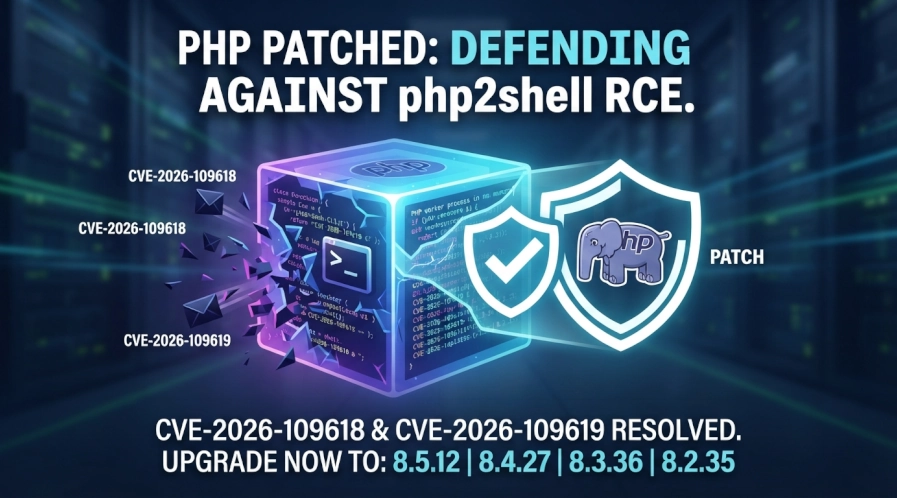
On October 21, 2026, the PHP development team issued an emergency set of security updates to address a pair of critical flaws that completely upend modern web security. Collectively dubbed “php2shell” by security researchers, these vulnerabilities allow unauthenticated attackers to achieve full remote code execution (RCE) on vulnerable servers. Given that PHP powers over 75% of all web applications on the internet, this development represents a massive threat landscape that demands immediate action from system administrators, DevOps teams, and web developers worldwide.
Understanding php2shell: The Flaws Explained
The php2shell advisory encompasses two distinct but deeply interrelated critical security vulnerabilities, each carrying a critical CVSS score of 9.2, initially detailed in the ProjectDiscovery Technical Advisory:
- CVE-2026-109618 (Out-of-Memory Request Cleanup Flaw): This is a memory-safety bug that triggers during request cleanup operations. When a PHP worker process encounters an out-of-memory (OOM) condition while processing a web request, it attempts to free allocated memory and gracefully close the lifecycle. However, a flaw in this routine causes memory corruption, allowing an attacker to manipulate the process memory and execute arbitrary code on the underlying operating system.
- CVE-2026-109619 (Stale Global State Flaw): This vulnerability revolves around data persistence within long-running worker processes. Instead of fully clearing out internal states between separate HTTP requests, a logical flaw causes stale global variables and state data to survive across sessions. This allows an attacker to poison the memory space or read sensitive application memory across different users’ requests.
The True Danger: Attack Surface and Impact
What makes php2shell particularly devastating is its universal impact. Often, PHP vulnerabilities only impact specific deployment configurations like the older Apache mod_php or CGI setups. However, php2shell affects all major PHP web-serving configurations, including:
- PHP-FPM (FastCGI Process Manager), the modern backbone of Nginx and Apache setups.
- Modern execution layers like FrankenPHP and LiteSpeed.
- Legacy environments like Apache
mod_phpandphp-cgi.
Because CVE-2026-109619 allows data leakage between unrelated HTTP requests, a successful exploit doesn’t just grant a shell to an attacker—it can also expose database passwords, active session tokens, application secrets, and API keys belonging to other users browsing the same application.
Patched Versions: Where You Need to Be
The PHP project has officially released updates across all actively supported branches. To safeguard your architecture, your servers must be upgraded to or past the following specific point releases:
- PHP 8.5.12
- PHP 8.4.27
- PHP 8.3.36
- PHP 8.2.35
The End-of-Life (EOL) Crisis
A significant complication of php2shell is its behavior on legacy systems. PHP versions 8.1, 8.0, and 7.x have officially reached their End-of-Life (EOL) and will not receive official upstream patches from the core PHP group.
If your organization relies on these older versions, you cannot simply run a standard package update to fix this issue. You must immediately evaluate alternative paths, such as migrating your codebase to PHP 8.2+, relying on commercial vendors who backport security fixes like the TuxCare Extended Lifecycle Support options, or deploying a temporary Web Application Firewall (WAF) rule to aggressively filter out malformed requests while you re-platform.
Your Step-by-Step Remediation Playbook
Securing your environment against php2shell requires more than just updating a binary. Follow this systematic playbook to ensure full protection and audit your environment for potential intrusion.
Step 1: Upgrade the Runtime and Base Images
Update your PHP installation using your operating system’s native package manager or by pulling updated container images.
On Ubuntu/Debian (via Ondřej Surý PPA):
sudo apt-get update && sudo apt-get --only-upgrade install php8.3For Docker Deployments: Update your Dockerfile base image definitions to point exactly to the patched micro-versions (e.g., php:8.3.36-fpm) and rebuild your images without caching (docker build --no-cache).
Step 2: Clear the Process Memory (Crucial)
Simply updating the files on disk does not fix currently running servers. The old, vulnerable code remains active inside the RAM of ongoing worker processes. You must explicitly restart your execution managers to flush the memory:
sudo systemctl restart php8.3-fpm
# Or if you are using Apache/Nginx directly:
sudo systemctl restart nginx
sudo systemctl restart apache2
Step 3: Conduct a Security and Post-Incident Audit
Because wild exploitation attempts were observed prior to the public disclosure on October 21, you must assume your servers might have already been targeted.
- Audit Active Sessions: Check for newly created or anomalous administrative accounts within your application databases.
- Scan for Web Shells: Look for unfamiliar, newly created
.phpfiles in your public web roots, particularly in user upload directories. - Credential Rotation: Because php2shell facilitates cross-request memory dumping, treat all application secrets (database credentials, encryption keys, and third-party API tokens) as potentially compromised. Schedule an immediate rotation of these secrets.
Final Thoughts
The php2shell vulnerability is a stark reminder of the security challenges built into long-running web processes and memory management routines. Because this exploit is unauthenticated and results in complete system compromise, ignoring it is not an option. Act today: inventory your PHP versions, push the necessary updates, and verify that your processes have been thoroughly restarted to clear out the vulnerable code.